
On 15 September every year, India marks Engineers Day on the birth anniversary of Sir Mokshagundam Visvesvaraya — the engineer whose dams, irrigation systems and flood defences still function more than a century after he designed them. It is a useful day to think about what engineering actually is, because most of it is invisible by design.
The Man the Day Honours
Sir M. Visvesvaraya was born in 1861 in a village in present-day Karnataka. He trained as a civil engineer, and over a career spanning decades he built irrigation systems, designed flood protection for Hyderabad, and served as Diwan of Mysore, where he pushed industrial and educational development as hard as he pushed infrastructure.
His automatic floodgate system, patented and installed at Khadakvasla and later used at the Krishna Raja Sagara dam, raised storage capacity without raising the dam wall. It was an elegant solution: solve the problem with better design rather than more material.
He received the Bharat Ratna in 1955. He worked into his nineties. And the thing most often repeated about him — that he was obsessive about precision, punctuality and doing work properly the first time — is the part worth carrying forward.
Good Engineering Is Invisible
Here is the uncomfortable truth about the profession: when engineering works, nobody notices it.
Nobody admires a building for not leaking. No one photographs a facade because the panels are still flat after ten summers. Nobody thanks the engineer who sized the framework correctly, because the failure that didn’t happen is not an event.
Engineering only becomes visible when it fails. A cladding panel that debonds and falls. A facade that traps moisture and rots the wall behind it. A joint detail that ignored thermal movement and buckled in the third summer.
The work that prevents all of that gets no credit — which is precisely why a day set aside to acknowledge it is worth keeping.
The Engineering Inside a Building Facade
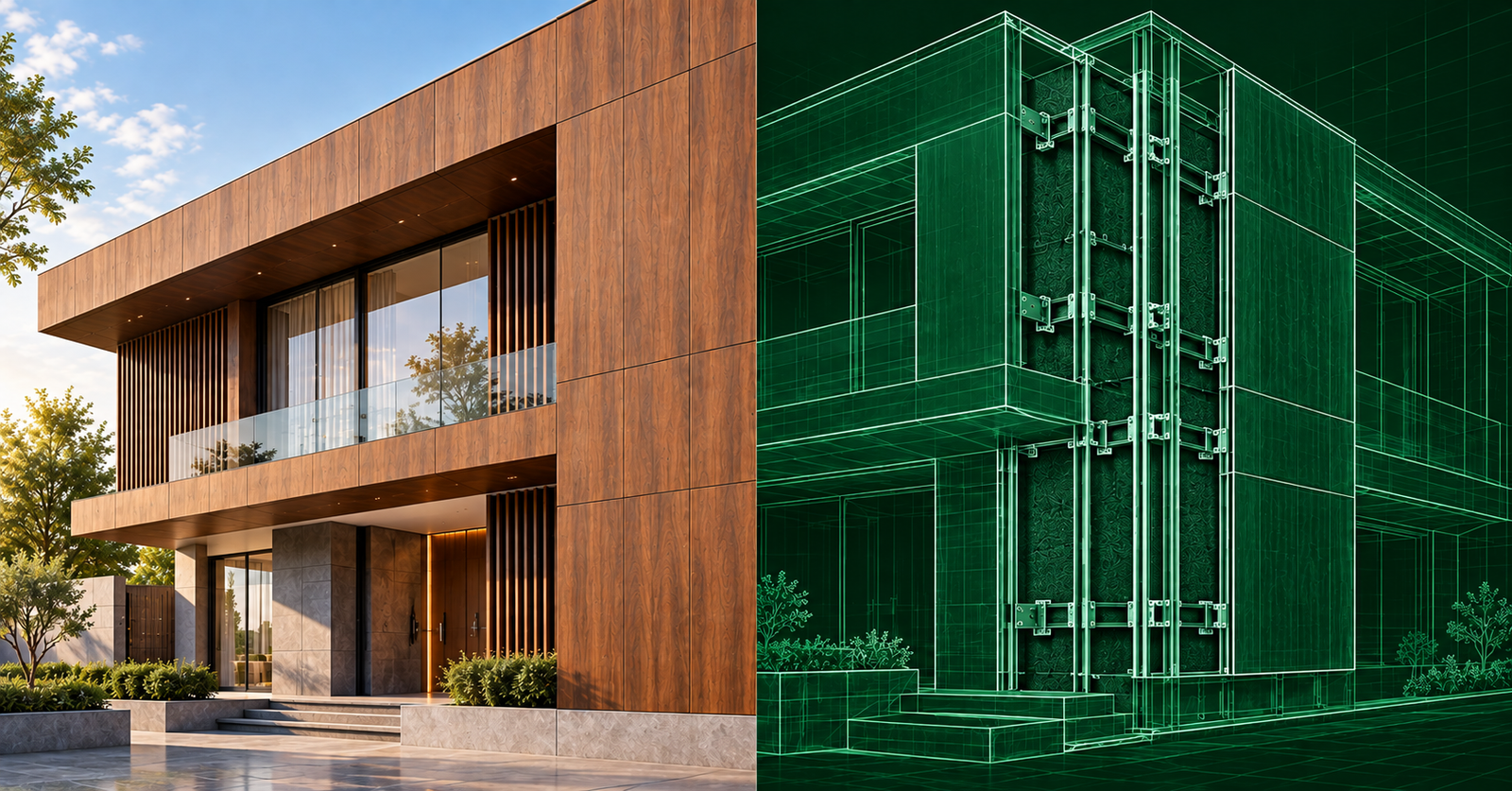
Most people looking at a building exterior see a surface. What is actually there is a system, and someone engineered every part of it.
- Wind load calculation — a facade panel on the eighteenth floor experiences forces a ground-floor panel never will. Panel thickness, framework spacing and fixing type all follow from that calculation, not from convention.
- Thermal movement — a facade surface in an Indian summer can swing more than 30 degrees between afternoon and dawn. Every material on that wall expands and contracts at a different rate. The joints have to absorb that difference for twenty-five years without complaint.
- Water management — a rainscreen does not try to be waterproof. It accepts that some water gets past the outer skin, and engineers a drained, ventilated cavity to get it back out. That is a design philosophy, not a product feature.
- Fire performance — the cavity that drains water can also carry fire upward. Cavity barriers at floor levels exist because someone worked out what happens when they don’t.
- Corrosion — the framework sits permanently inside a humid cavity where nobody will ever inspect it. Material selection there is a fifty-year decision made once.
None of this is visible in the finished building. All of it determines whether the building is still sound in 2050.
Visvesvaraya’s Actual Lesson
The lesson usually drawn from Visvesvaraya is about discipline and hard work. That is true but incomplete.
The more useful lesson is in the floodgate design itself. Faced with the need for more water storage, the obvious answer was a bigger dam — more concrete, more money, more time. He found a way to get more capacity from the structure that already existed.
That instinct — solve it with better design rather than more material — is the same instinct behind good facade engineering today. A correctly designed ventilated cavity does more for a building’s thermal performance than an extra layer of anything. A properly calculated framework grid uses less steel than an over-specified one and performs better. Getting the detail right at the junction costs nothing and prevents everything.
Under-specifying is a failure. Over-specifying is also a failure — it is just a more expensive and less obvious one.
To the Engineers Who Work on Facades
This day belongs to the structural engineers who run the wind loads, the facade consultants who detail the junctions nobody will ever see, the site engineers who catch the framework spacing error before the panels go up, and the installation supervisors who insist the expansion gaps stay open when everyone wants the joint to look tighter.
It also belongs to the engineers on the manufacturing side — the ones who set press parameters, run the weathering tests, and reject a batch that would probably have been fine.
Nobody outside the industry will ever know your name is attached to that building. That is what doing the job properly looks like.
Where We Stand
At HPLMaker, we make exterior cladding panels. We are one component in a system that engineers design, specify and assemble — and the system matters more than any single part of it.
The best thing a manufacturer can do on Engineers Day is not claim credit for buildings other people engineered. It is to make the engineer’s job easier: publish real technical data, provide test certificates without being chased, state what a product can and cannot do, and be honest about the limits.
An engineer specifying a facade needs accurate numbers, not adjectives. We try to remember that.
Happy Engineers Day
To every engineer working on Indian construction — on sites, in design offices, in factories, in testing labs — thank you for the work nobody notices.
Sir Visvesvaraya’s dams are still holding. That is the standard.
HPLMaker manufactures exterior-grade HPL cladding panels. For technical data sheets, test certificates or specification support on your project, get in touch with our technical team.